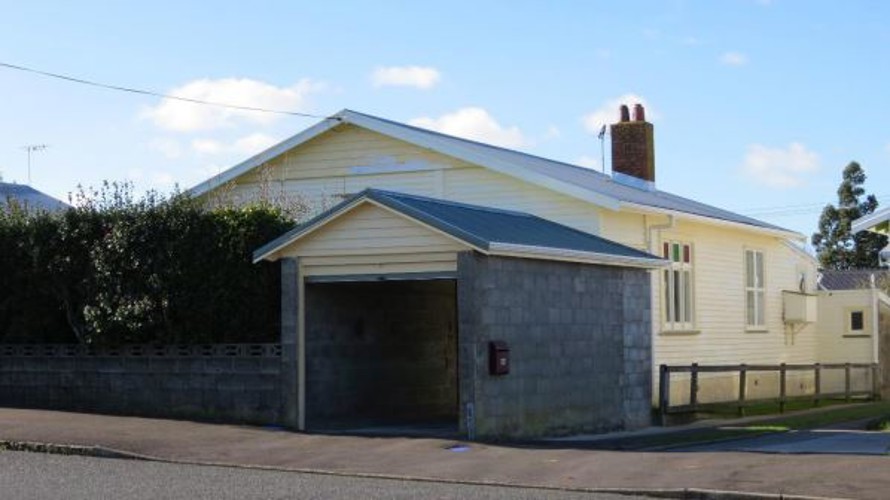
 Walker's Workers' Dwelling, 23 Paynters Ave. Hamish Crimp (2019).
Walker's Workers' Dwelling, 23 Paynters Ave. Hamish Crimp (2019).
Walker's Workers' Dwelling, 23 Paynters Ave. Hamish Crimp (2019).
By 1916, New Plymouth, along with other New Zealand towns and cities, was grappling with a severe housing shortage. At this time it was reported that two families occupying one dwelling was not uncommon, new residents were forced into lodgings, and the Borough Council was losing employees who could not find residence in the town.
As a means to improve both the supply and standard of worker housing, the Liberal Government had previously passed the first Workers Dwellings Act in 1905. Whilst this Act was revolutionary, it was largely unsuccessful due to high construction costs and a suburban emphasis which failed to recognise the need for workers to live near their places of employment.
A new Workers’ Dwellings Act with strengthened freehold provisions was passed in 1910. Under the new Act, the State was prepared to build landless urban workers their own house for just a £10 deposit, and whilst workers could still lease or rent from the state, applicants who were prepared to own were favoured.
Eventually suitable land was found in the eastern New Plymouth suburb of Strandon, where sections 11, 12 and 13 of Chilman’s Subdivision, Paynter’s Avenue, were purchased by the government from Daniel Barry and subsequently subdivided into four lots during July 1917. The new subdivision would be known as Hooper’s Workers’ Dwelling’s Settlement, and tenders were called for the erection of four Workers' Dwellings at New Plymouth.
Initial tenders were considered too high for the type of dwelling being constructed, however after applicants agreed to double their deposits from £10 to £20, new designs were prepared. By January 1918, it seems all the homes were nearing completion, with the builder Luke Langridge, advertising for a "good painter and paper-hanger" at the Paynters Avenue Workers' Dwellings. A Taranaki Daily News reporter described them in March 1918 as having "nothing of the monotonous and forbidding appearance usually conceived when 'workers' dwellings' are mentioned".
The carpenter John Walker completed his payments on this property and purchased it for £723 17s 6d from the Crown in mid-1926, with the Certificate of Title issued at this time.
Related item:
Taranaki DP3580 Sheet 1 Workers' Settlement, ICS Pre 300,000 Cadastral Plan Index (Imaged by LINZ)
Please do not reproduce these images without permission from Puke Ariki.
Contact us for more information or you can order images online here.
The information on this website is provided for general research and reference only. While we try to keep content accurate and current, we make no guarantees about its completeness or correctness. It should not be considered a replacement for a LIM or a Property Report. Some content is supplied by third parties. Puke Ariki has not verified this content and users should check its accuracy before relying on it.The inclusion of a building on the website does not imply heritage status. See SCHED1 in the NPDC District Plan for a list of buildings that have rules about what can happen to or around them (administered by NPDC). See the New Zealand Heritage List for a list of buildings that are celebrated for their heritage significance but are not subject to rules (administered by Heritage New Zealand Pouhere Taonga). Should any corrections need to be made to the records or for more information please contact us.


