


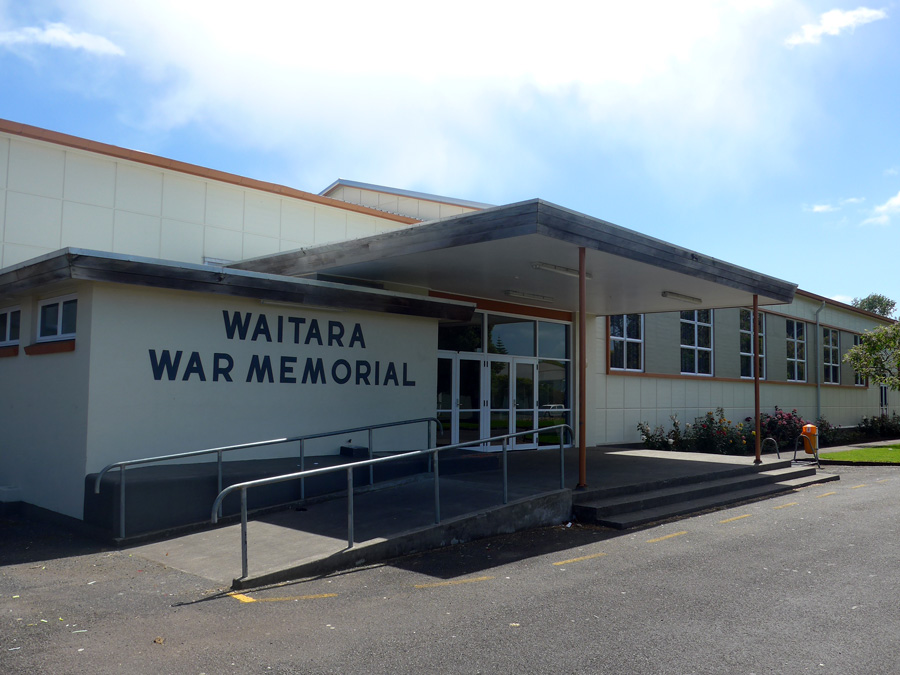
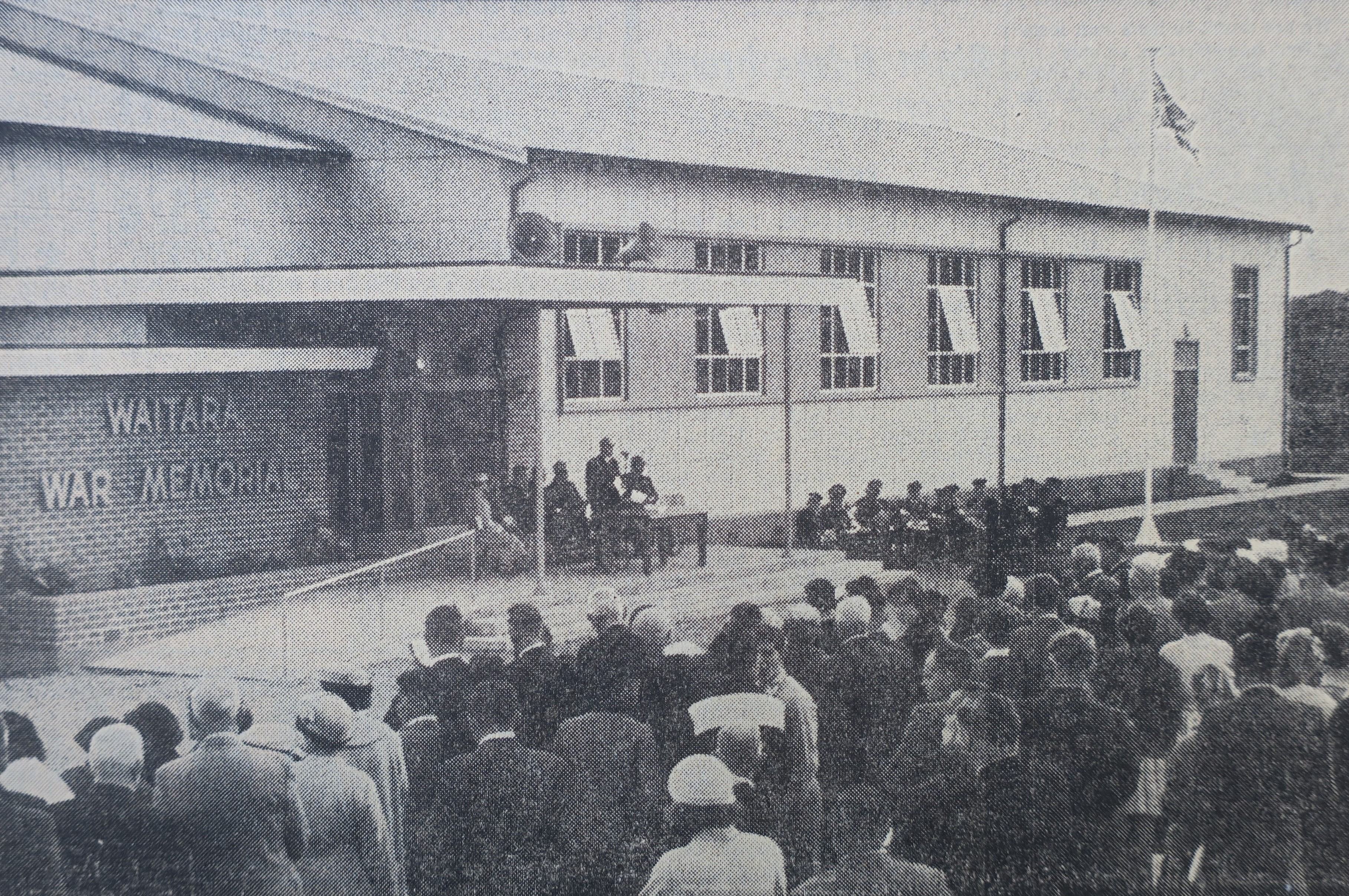
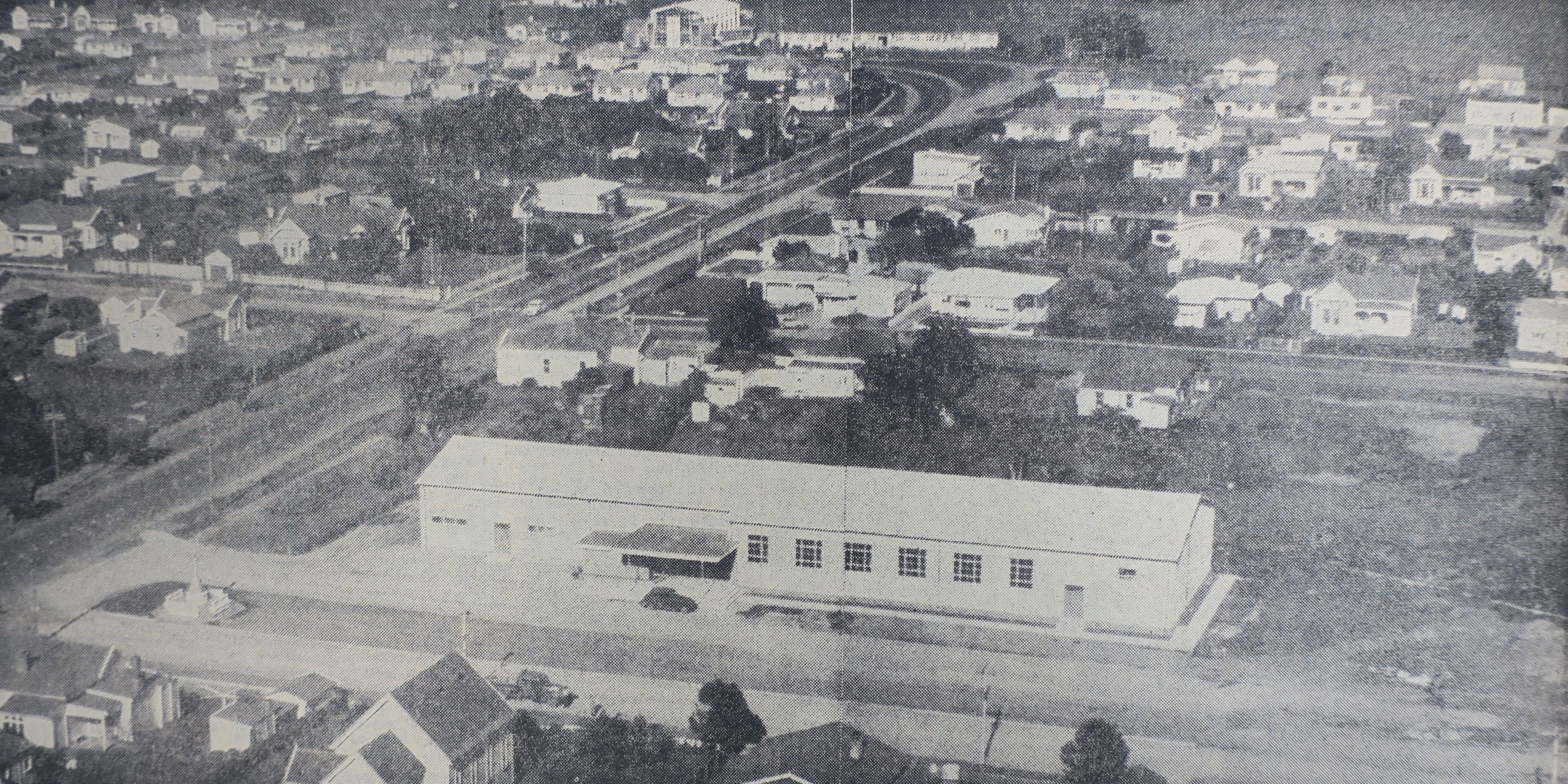
Waitara's War Memorial Hall was officially opened on Sunday 13 September 1959.
One of the three largest buildings in Waitara at the time, and the largest hall in the district, it featured a games room big enough to accommodate a full-sized basketball court plus four badminton courts, a concert hall with stage, dressing rooms and seating for 500 people, a kitchen, canteen, cloakrooms, toilets and showers as well as a large entrance foyer with its own ticket box.
Plans to create a public memorial for the town to the Second World War began in 1947 when it was suggested that a children’s playground might be an appropriate form of commemoration. But residents could not agree and four years passed before the Waitara Borough Council called a public meeting and put the matter to a vote. Ninety per cent of respondents preferred some form of community centre instead so in 1952 a committee was formed to raise the necessary funds.
In less than a year an impressive £22,000 had been gathered, prompting the government to provide a pound-for-pound subsidy which meant a total of £45,000 to lay out the grounds, construct the hall and erect a suitable monument in the entrance foyer.
Christchurch construction firm C.S. Luney Ltd. commenced building work in 1958 on two acres of land purchased by the Borough Council from the Catholic Church. All structural steel in the building was fabricated and erected by the National Dairy Association in Hāwera, with electrical work done by Claude Drury of New Plymouth, plastering by C.W.A. Cairns Ltd. and the plumbing and drain laying carried out by John Patrick Casey & Son of New Plymouth. Walsh’s music store in Waitara supplied the hall’s impressive grand piano.
It took three weeks just to form the kerbs outside, with lawns and flower beds sown around the hall and concrete footpaths constructed the following summer at the same time as the street – originally part of Broadway but renamed once the hall was opened – was sealed.
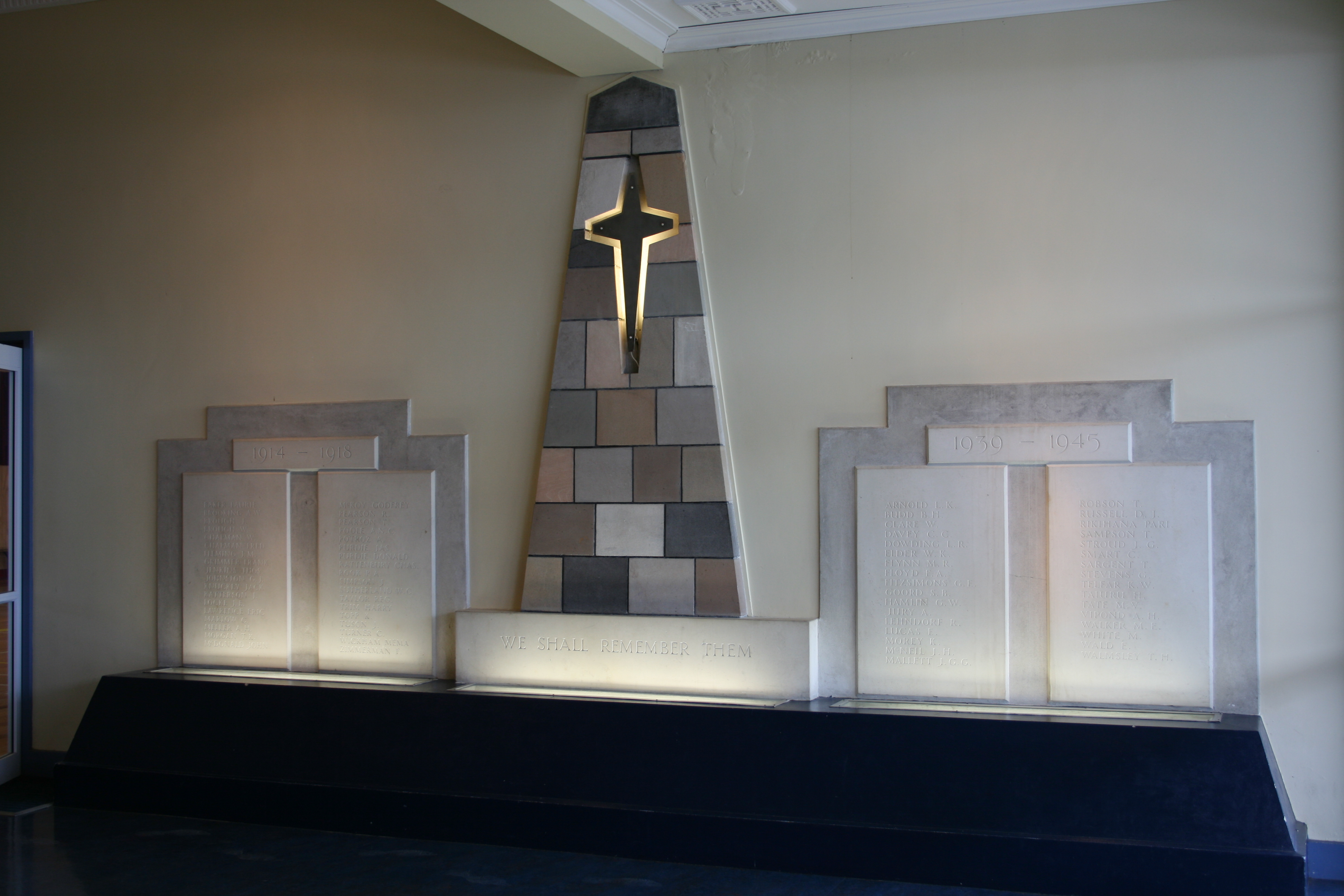
The monument in the hall’s lobby was designed by Maxwell (Max) George Smart (1922-1962), Art Master at Waitara High School, and constructed by Shorts Monumental Works in New Plymouth. The coloured stone installation features an illuminated cross, an exact miniature of the Cross of Sacrifice at the Waitara soldiers' cemetery. It also includes the inscription We shall remember them and four marble tablets listing the names of 67 local men who gave their lives in the First and Second World Wars.
The War Memorial Hall was opened by Minister of Internal Affairs William Anderton. Mayor of Waitara William Roy Yardley was also present, as well as the MP for Stratford, Thomas Templeton Murray, and President of the Waitara RSA, Peter (Akapita) Winterburn. Rounding out the official party were the Archdeacon of Taranaki, Gordon Hay Gavin, and the Reverend Munga Cameron, Māori missioner for the Waitara district. Listening to the speeches was a crowd of 2000 people but some others who may have wished to attend could not as, interestingly, Francis Douglas Memorial College was opened in New Plymouth on the same day.
The hall was made available to community groups rent-free for a week of festivities after the opening – an indoor bowling tournament was held, as well as gymnastic displays and an inaugural ball put on by the RSA with musical entertainment provided by the Lambert Sisters and Topliner.
The new hall was also designed in part to house the Waitara Little Theatre Society. Formed in 1946, the society purchased the old Foresters’ Hall for staging their productions. However, in 1953 the Society sold that building and donated the proceeds to the Memorial Hall fund, moving their shows to the Theatre Royal while the hall was being built. The first play staged in the hall, on 14 September 1959, was a three-act comedy called “As long as they’re happy” by Vernon Sylvaine.
Waitara War Memorial Hall underwent substantial refurbishment in 2004 but in 2013 it was determined that the theatre section had a seismic capacity of just 25% of the new building standard, while the remaining parts – the gymnasium, kitchen and foyer – met only 45-49% and were thus an earthquake risk. New Plymouth District Council's Earthquake-Prone Buildings Policy required public buildings to meet at least 34% of the standard and encouraged owners to strengthen buildings to 67% or higher. As a consequence, the hall was closed on 20 February 2019 for a $1.4 million renovation including earthquake strengthening. It reopened the following year, in time to become a Covid testing centre.
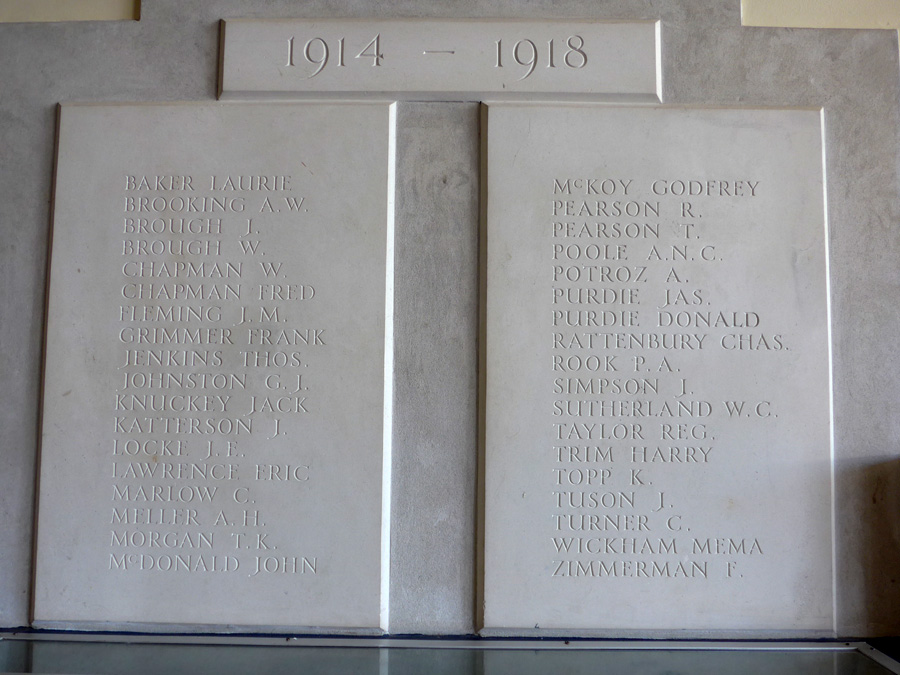
Marble plaque 1914-1918:
Baker, Laurie
Brooking, A.W.
Brough, J.
Brough, W.
Chapman, W.
Chapman, Fred
Fleming, J.M.
Grimmer, Frank
Jenkins, Thos.
Johnston, G.J.
Knuckey, Jack
Katterson, J.
Locke, J.E.
Lawrence, Eric
Marlow, C.
Meller, A.H.
Morgan, T.K.
McDonald, John
McKoy, Godfrey
Pearson, R.
Pearson, T.
Poole, A.N.C.
Potroz, A.
Purdie, Jas.
Purdie, Donald
Rattenbury, Chas.
Rook. P.A.
Simpson, J.
Sutherland, W.C.
Taylor, Reg.
Trim, Harry
Topp, K.
Tuson, J.
Turner, C.
Wickham, Mema
Zimmerman, F.
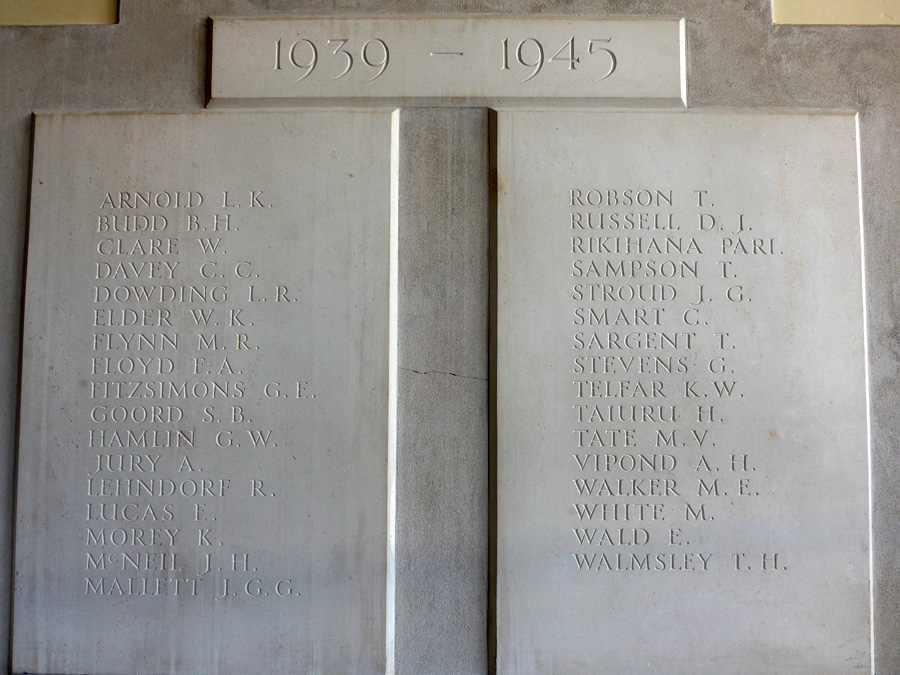
Marble plaque 1939-1945:
Arnold, L.K.
Budd, B.H.
Clare, W.
Davey, C.C.
Dowding, L.R.
Elder, W.K.
Flynn, M.R.
Floyd, F.A.
Fitzsimons, G.E.
Goord, S.B.
Hamlin, G.W.
Jury, A.
Lehndorf, R.
Lucas, E.
Morey, K.
McNeil, J.H.
Mallett, J.G.G.
Robson, T.
Russell, D.J.
Rikihana, Pari
Sampson, T.
Stroud, J.G.
Smart, C.
Sargent, T.
Stevens, G.
Telfar, K.W.
Taiuru, H.
Tate, M.V.
Vipond, A.H.
Walker, M.E.
White, M.
Wald, E.
Walmsley, T.H.
Related documents
Minister opens Waitara war memorial community centre (Taranaki Herald 14 September 1959)
Two notable openings (Taranaki Herald 12 September 1959)
Please do not reproduce these images without permission from Puke Ariki.
Contact us for more information or you can order images online here.


