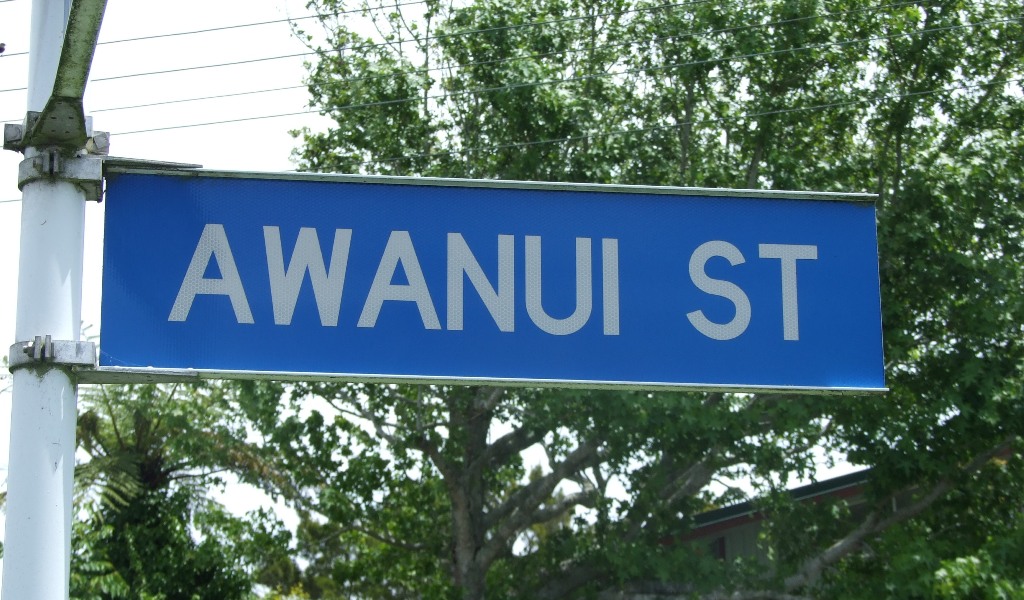
Awanui in Māori often refers to a deep cutting or gully and is sometimes translated as an avenue. It is thought the name in the New Plymouth context probably refers to the fact that the street traverses the wide and deep Hēnui valley.
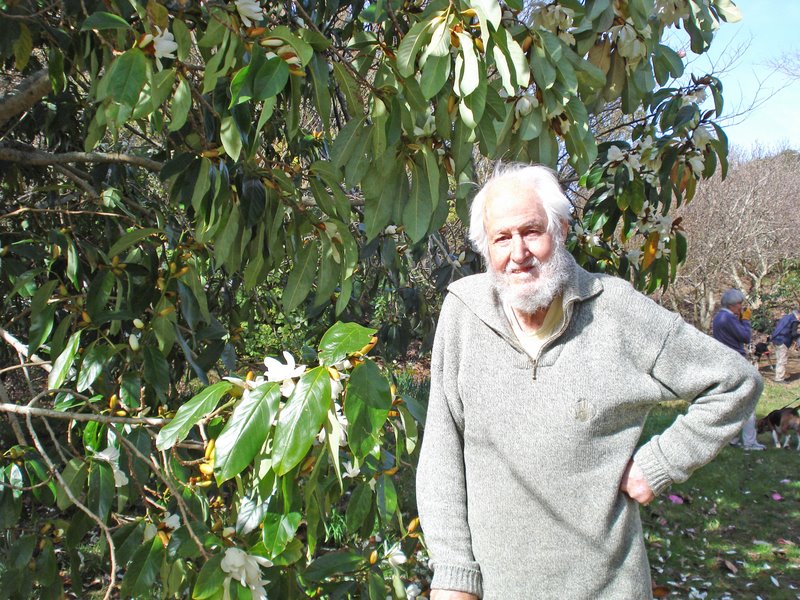
The name has gone on to become internationally recognised by gardeners and plants people as a very attractive cultivar of a flowering cherry. New Plymouth horticulturist Keith Adams developed it on the 8 hectare property he bought in 1950 that could be accessed from Awanui Street. At that stage the street was only a small dirt road on the outskirts of New Plymouth. The current Te Mara Place was once the Adams' front gate.
Adams planted his farm in many prunus species on the advice of a friend. One of the Yoshino (or Tokyo) cherries turned out to be a stunner and, on the advice of Sir Russell Matthews, he quickly began propagating it. In fact Sir Russell took the first six for his garden at Tūpare and "Awanui" was born.
Today no supplier of flowering cherries would be without Prunus yedoensis 'Awanui' or simply Awanui. It is described as an upright tree with layered branches and masses of pink white flowers hanging in racemes, which fall to form a dense carpet underneath. It is truly a magnificent sight in any spring garden.
The name comes from the area and the insignificant road that led to Keith Adams' property. There is no doubt the beauty of the valley and the tree that bears its name serves to put New Plymouth on the map and celebrate the work of a talented plant collector and breeder.
This story was originally published in the Taranaki Daily News.
Related items:
New Street Names (Taranaki Daily News 7 April 1936)
Awanui Street Aerial (Taranaki Herald 22 October 1969)
Please do not reproduce these images without permission from Puke Ariki.
Contact us for more information or you can order images online here.
The information on this website is provided for general research and reference only. While we try to keep content accurate and current, we make no guarantees about its completeness or correctness. It should not be considered a replacement for a LIM or a Property Report. Some content is supplied by third parties. Puke Ariki has not verified this content and users should check its accuracy before relying on it.The inclusion of a building on the website does not imply heritage status. See SCHED1 in the NPDC District Plan for a list of buildings that have rules about what can happen to or around them (administered by NPDC). See the New Zealand Heritage List for a list of buildings that are celebrated for their heritage significance but are not subject to rules (administered by Heritage New Zealand Pouhere Taonga). Should any corrections need to be made to the records or for more information please contact us.