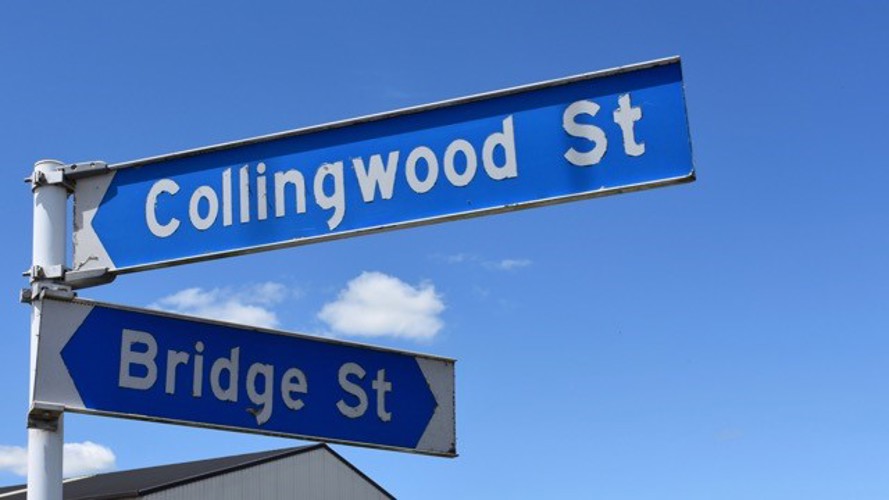
 Collingwood Street sign (2020). Mike Gooch. Word on the Street image collection.
Collingwood Street sign (2020). Mike Gooch. Word on the Street image collection.
Collingwood Street sign (2020). Mike Gooch. Word on the Street image collection.
The development of Taumata Park in Eltham encouraged private land owners in the vicinity to sub-divide their land for housing. Collingwood Street is one such example.
The Bridger family of Nelson had arrived in Eltham in the mid-1890s. They owned land between the park and the railway line. In the early 1900s they formed the northern end of Collingwood Street, from Clifford Road to Park Street. The street was named after their old family home in the Nelson area.
In 1909 the Eltham Borough Council extended the street south, to Bridge Street. There is a suggestion that some people wanted the extension to have a different name. They preferred ‘Blackhall Street’, presumably after the Eltham councillor of the same name. The council was required to hold a meeting, at which Collingwood Street was confirmed.
When Saunders Park was developed in the 1950s, initially for use as a hockey ground, separate access was through gates on Collingwood Street.
The Bridger family would go on to make further contributions to the town of Eltham. Only 9 years old when he arrived with his family, Ira Bridger later owned a bicycle shop and was elected the town’s mayor in 1925.
He is remembered for organizing much government-funded relief work during the depression years. Later he moved to Auckland and worked as the director-general of Red Cross. Bridger Park is named after him.
This story was originally published in the Taranaki Daily News.
Please do not reproduce these images without permission from Puke Ariki.
Contact us for more information or you can order images online here.
The information on this website is provided for general research and reference only. While we try to keep content accurate and current, we make no guarantees about its completeness or correctness. It should not be considered a replacement for a LIM or a Property Report. Some content is supplied by third parties. Puke Ariki has not verified this content and users should check its accuracy before relying on it.The inclusion of a building on the website does not imply heritage status. See SCHED1 in the NPDC District Plan for a list of buildings that have rules about what can happen to or around them (administered by NPDC). See the New Zealand Heritage List for a list of buildings that are celebrated for their heritage significance but are not subject to rules (administered by Heritage New Zealand Pouhere Taonga). Should any corrections need to be made to the records or for more information please contact us.


