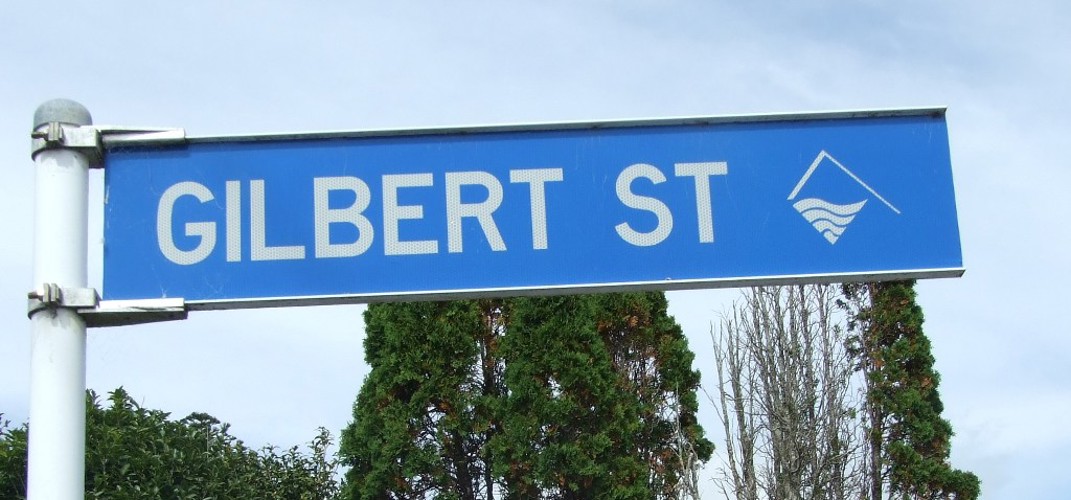
 Gilbert Street sign (2013). Mike Gooch. Word on the Street image collection.
Gilbert Street sign (2013). Mike Gooch. Word on the Street image collection.
Gilbert Street sign (2013). Mike Gooch. Word on the Street image collection.
Gilbert Street is named after William John Gilbert Esquire, a director of the Plymouth Company. Putting his name to a prospectus of the New Zealand Company in 1842, he gave his address as Lichfield, in Staffordshire.
It is likely that our William John Gilbert was Assistant Poor Law Commissioner for the South Western District, including Devon and Cornwall. His reports, held in the British National Archive, were written in 1837.
The Poor Law Amendment Act 1834, passed by the British Parliament to reform the country's poverty relief system, centralised responsibility for paupers. The Poor Law Commission oversaw national operations; parishes were amalgamated into Poor Law Unions and workhouses were built. To act as a deterrent, working conditions inside the workhouse had to be worse than the worst job possible outside, a 'principle of less eligibility' to deter people from claiming poor relief. Charles Dickens' Oliver Twist, serialised from 1837 to 1839, criticised the Poor Law and its workhouses.
Gilbert's 1837 report mentioned unemployed lace makers, the depression in glove making, an idle carpet factory in Axminster, and fluctuations in the money market. “Wages are at present too low to allow the Agricultural Labourer the means of supporting himself and a wife and family consisting of 4 or 5 children.” Little wonder that people suffered from emigration fever.
We note that William Gilbert, the shoemaker memorable for sewing the first rugby ball, is not our man.
This story was originally published in the Taranaki Daily News.
Please do not reproduce these images without permission from Puke Ariki.
Contact us for more information or you can order images online here.
The information on this website is provided for general research and reference only. While we try to keep content accurate and current, we make no guarantees about its completeness or correctness. It should not be considered a replacement for a LIM or a Property Report. Some content is supplied by third parties. Puke Ariki has not verified this content and users should check its accuracy before relying on it.The inclusion of a building on the website does not imply heritage status. See SCHED1 in the NPDC District Plan for a list of buildings that have rules about what can happen to or around them (administered by NPDC). See the New Zealand Heritage List for a list of buildings that are celebrated for their heritage significance but are not subject to rules (administered by Heritage New Zealand Pouhere Taonga). Should any corrections need to be made to the records or for more information please contact us.


