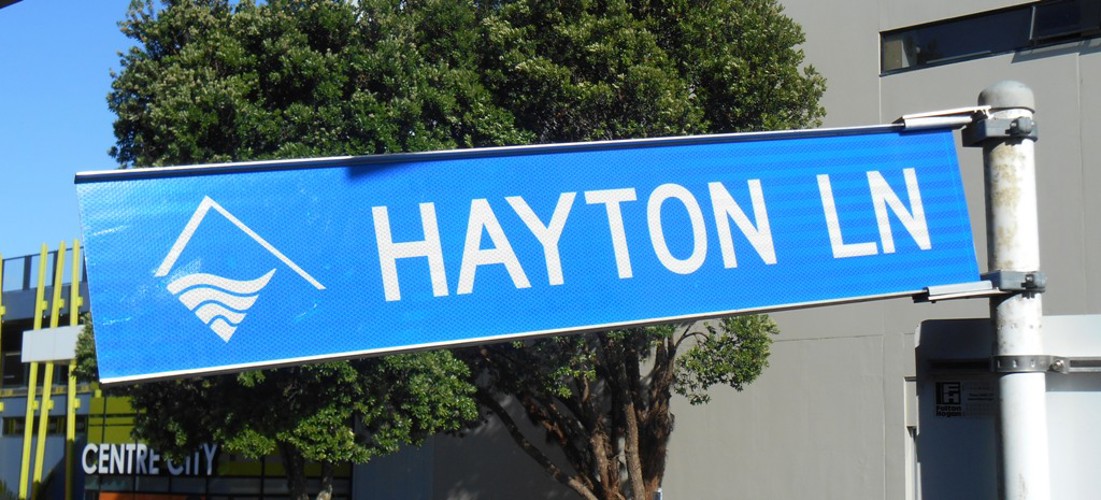
 Hayton Lane sign. Mike Gooch. Word on the Street image collection.
Hayton Lane sign. Mike Gooch. Word on the Street image collection.
Hayton Lane sign. Mike Gooch. Word on the Street image collection.
As inner-city land prices increase, large sections are subdivided to intensify land use. Lanes are formed to provide access to the newly created sections. Such is the function of Hayton Lane, connecting to Gill Street in New Plymouth's CBD.
The earliest mention of the lane on local survey maps is 1966, but its story goes back much further than that. During the 1920's, the entrepreneurial Ernest Hayton commissioned a building in Gill Street to house the plumbing supplies business, Hayton and Co. The company traded there for over 70 years, and the building still stands today. Ernest was very active in the community, including service as a Justice of the Peace. He died in 1972.
Well before then, his son, Stuart, was managing the family plumbing business. Stuart was even more prominent in community affairs than his father. Amongst various community roles, he was best known for his involvement in Rotary, Toastmasters, the Taranaki Harbour Board and 55 years’ service as a Justice of the Peace. He was made a Commander of the Most Excellent Order of the British Empire (C.B.E.) for his contribution to the community in 1984. Remarkably, he drove until the age of 99 and enjoyed using new technology such as the internet. Stuart died at the age of 100 in 2011.
Survey plans from 1966 note the lane to be "vested as a service lane", and it wasn't until 1980 that the name Hayton was formally given to the lane. In 1995, the Hayton and Co. plumbing business closed, but the name of the lane remains to commemorate a family that contributed so much to the New Plymouth community.
This story was originally published in the Taranaki Daily News.
Please do not reproduce these images without permission from Puke Ariki.
Contact us for more information or you can order images online here.
The information on this website is provided for general research and reference only. While we try to keep content accurate and current, we make no guarantees about its completeness or correctness. It should not be considered a replacement for a LIM or a Property Report. Some content is supplied by third parties. Puke Ariki has not verified this content and users should check its accuracy before relying on it.The inclusion of a building on the website does not imply heritage status. See SCHED1 in the NPDC District Plan for a list of buildings that have rules about what can happen to or around them (administered by NPDC). See the New Zealand Heritage List for a list of buildings that are celebrated for their heritage significance but are not subject to rules (administered by Heritage New Zealand Pouhere Taonga). Should any corrections need to be made to the records or for more information please contact us.


