

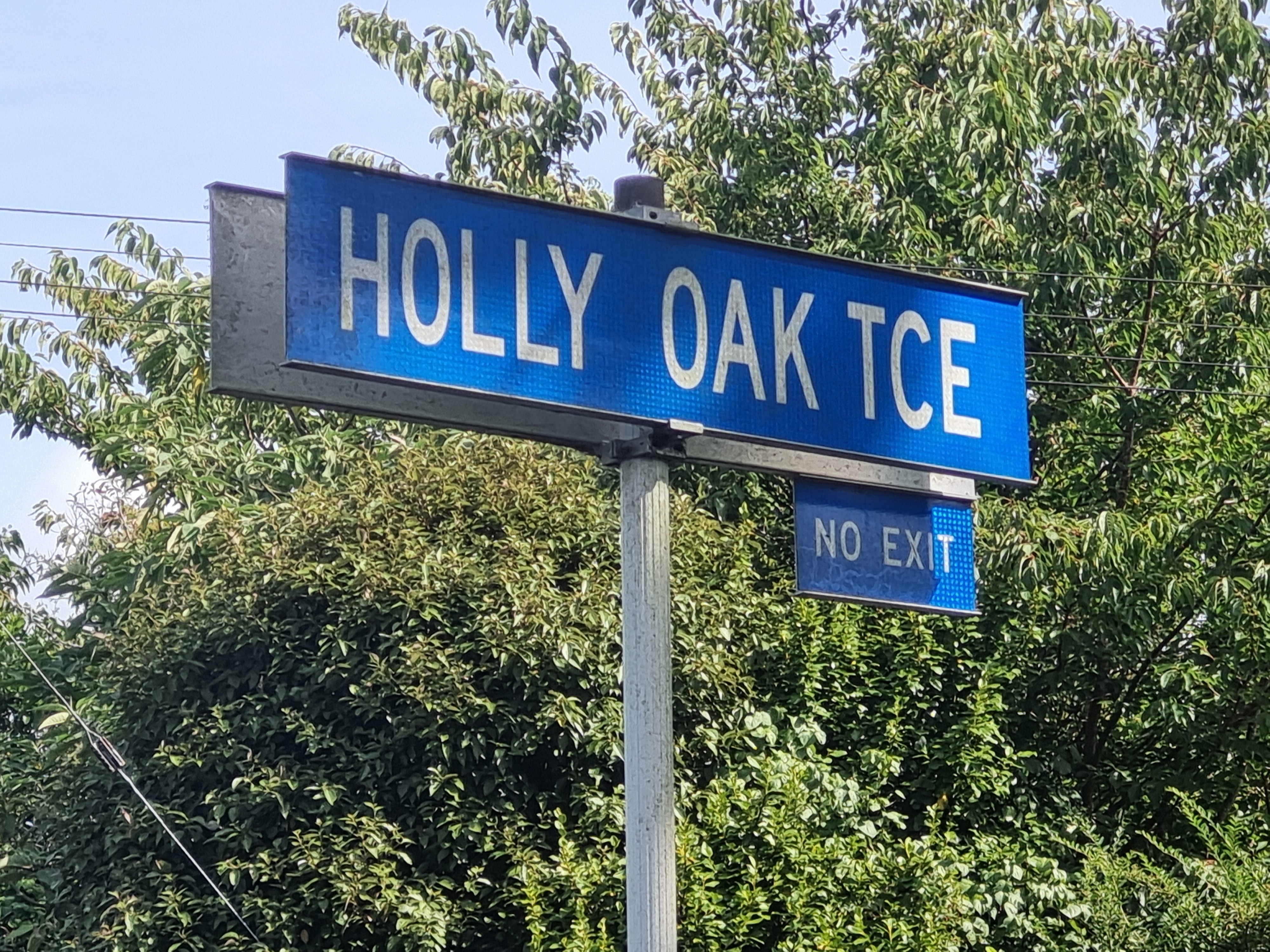
Holly Oak Terrace in New Plymouth carries a name steeped in both botanical and local history.
The term “Holly Oak” refers to Quercus ilex, also known as the Holm Oak, an evergreen species native to the Mediterranean. Its glossy, holly-like leaves inspired the name, though it is not a true holly.
The street was created in 1990 to create access to properties off Junction Road and was named after an adjoining farm with historical significance: Holly Oak Farm.
As to why the owner of the farm, John Hale, named his land after this tree, the reason is unclear. There are no listed notable trees of this type on this property but perhaps there was in the past, or maybe John Hale had a particular affinity for the tree – once prized for its medicinal uses and hard, durable wood useful for construction.
Holly Oak farm was the life’s work of Hale, at one time one of New Zealand’s most celebrated Jersey cattle breeders. Born in Motueka in 1867, Hale moved to Taranaki after his marriage to Lucy Jackson Hughes in 1892 and began farming on Albert Road, before initially leasing this property on Junction Rd (at the time known as Avenue Road) from surveyor Thomas Gore Sole in 1895.
His farm soon became synonymous with excellence in dairy breeding. By the 1920s, Hale’s herd of pedigree Jersey cattle was considered among the finest in the country, earning him national and even international recognition.
John and Lucy raised ten children on the farm; however their lives were not without tragedy. In 1909 their 14-year-old son Newton was shot by accident by another boy while hunting in the area. At the inquest, held two days after the tragedy, it was noted; “It was a painful scene, the father and the younger brother of the deceased evincing deep distress, which it was physically impossible to keep under control”. Then in 1936 another son, Eric, was killed after being crushed between two logs while sawmilling near Inglewood.
Despite these losses, Hale continued to build his reputation, advertising his “world-renowned” Holly Oak Jerseys in newspapers and contributing to the local community. He donated land for the Mangorei School in 1926 and to a local Scouts group for a troop bush hut in 1940 and frequently appeared in farming journals as a model of practical agriculture. He also lent his name to the promotion of various farming products, like locally produced Sykes’s Drench.
For decades, Holly Oak was a landmark in the Mangorei area and even after the property was sold in the late 1930s, its Jersey bloodlines carried on with at least one son, Duncan, still selling Holly Oak stud stock in 1945.
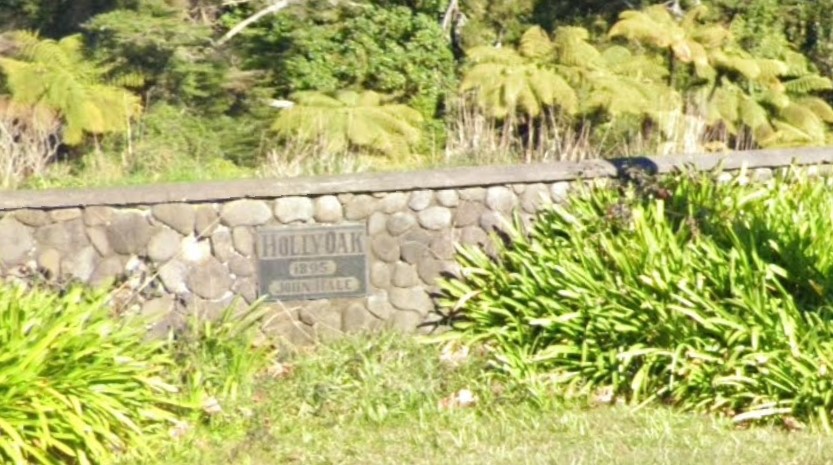
Apart from the road name, Holly Oak Farm is also memorialised in a plaque on a stone fence at the end of Holly Oak Terrace which bears the inscription: “Hollyoak 1895, John Hale,” a quiet tribute to a man whose passion for farming influenced Taranaki’s dairy industry.
John Hale died on 28 June 1948 and is buried in Te Henui Cemetery and his wife Lucy died in 1953.
Contributed by the Taranaki Research Centre I Te Pua Wānanga o Taranaki at Puke Ariki. Find this and hundreds of other street histories on NPDC’s Puke Ariki website: https://terangiaoaonunui.pukeariki.com/story-collections/word-on-the-street
Documents
Practical farmers, Taranaki Daily News 12 August 1922
Premier daily herd, Taranaki Daily News 31 May 1924
Holly Oak consignment, Taranaki Daily News 23 May 1936
SO 7400, Institute of Cadastral Surveying (Inc)
Please do not reproduce these images without permission from Puke Ariki.
Contact us for more information or you can order images online here.


