


Kāhui Road runs west from Te Papa-Kura-o-Taranaki (formerly Egmont National Park) to the sea and is divided into Lower, Mid and Upper sections. It passes through Rahotū and was named after a local rangatira with a shifting reputation.
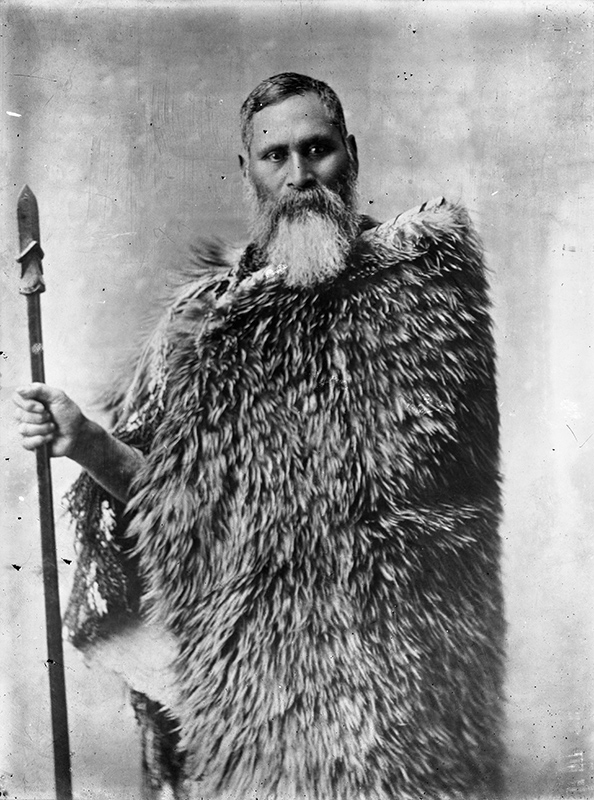
Born in 1846, as a young man Wiremu Te Kāhui Kararehe had been connected with Te Ua Haumēne and the more militant followers of his Pai Mārire religion. However, by the time a reporter from the Taranaki Herald met him in 1872 he was described as “a tall, intelligent looking chief”, leading a work party of 25 men at Te Namu Pā building roads and draining swamps.
Later that year a scandal broke out involving Te Kāhui and Lydia (Rīria) Tinirongoā Holder, the wife of another chief. The couple had fallen in love after meeting at Parihaka and left their respective spouses to elope. Te Kāhui’s hapū, Ngāti Haupoto, paid the price when a raiding party from the surrounding villages came to exact “the native law of muru”. Eleven whare were burnt and livestock exchanged in order to restore peace. Te Kāhui and Lydia then moved to Rahotū where they remained together and had nine children.
In 1878 the press noted that Te Kāhui had purchased two threshing machines to harvest 300 acres of wheat. They were gratified that he appeared to have seen “the advantages of… civilisation” but disappointed when he joined the prophets Te Whiti and Tohu in their struggle to maintain ownership of Māori land, calling him “full of deceit” and “slippery as an eel”.
Jailed in 1880 for his resistance to land confiscations, upon his release Te Kāhui chose to use the Pākehā legal system to help Māori whose whenua had been affected. He established a school at Rahotū, became involved in local politics and was published in the Journal of the Polynesian Society. By the time Te Kāhui died on 7 September 1904, he was hailed as “a loyal subject in his allegiance to the Crown”.
Kāhui Hut is also located on the western side of the maunga, 800 metres above sea level and a six-hour return walk from Kāhui Road. Built in 1903 on what were once the kumara gardens of an ancient pā, then dismantled in 1955 due to rot, the hut was rebuilt by the Taranaki Alpine Club and reopened on 12 May 1957. It serves as a search and rescue base for trampers staying overnight on their way to the summit.
This story was originally published in the Taranaki Daily News.
Wiremu Te Kāhui Kararehe (Te Ara - The Encyclopedia of New Zealand)
LinkPlease do not reproduce these images without permission from Puke Ariki.
Contact us for more information or you can order images online here.


