


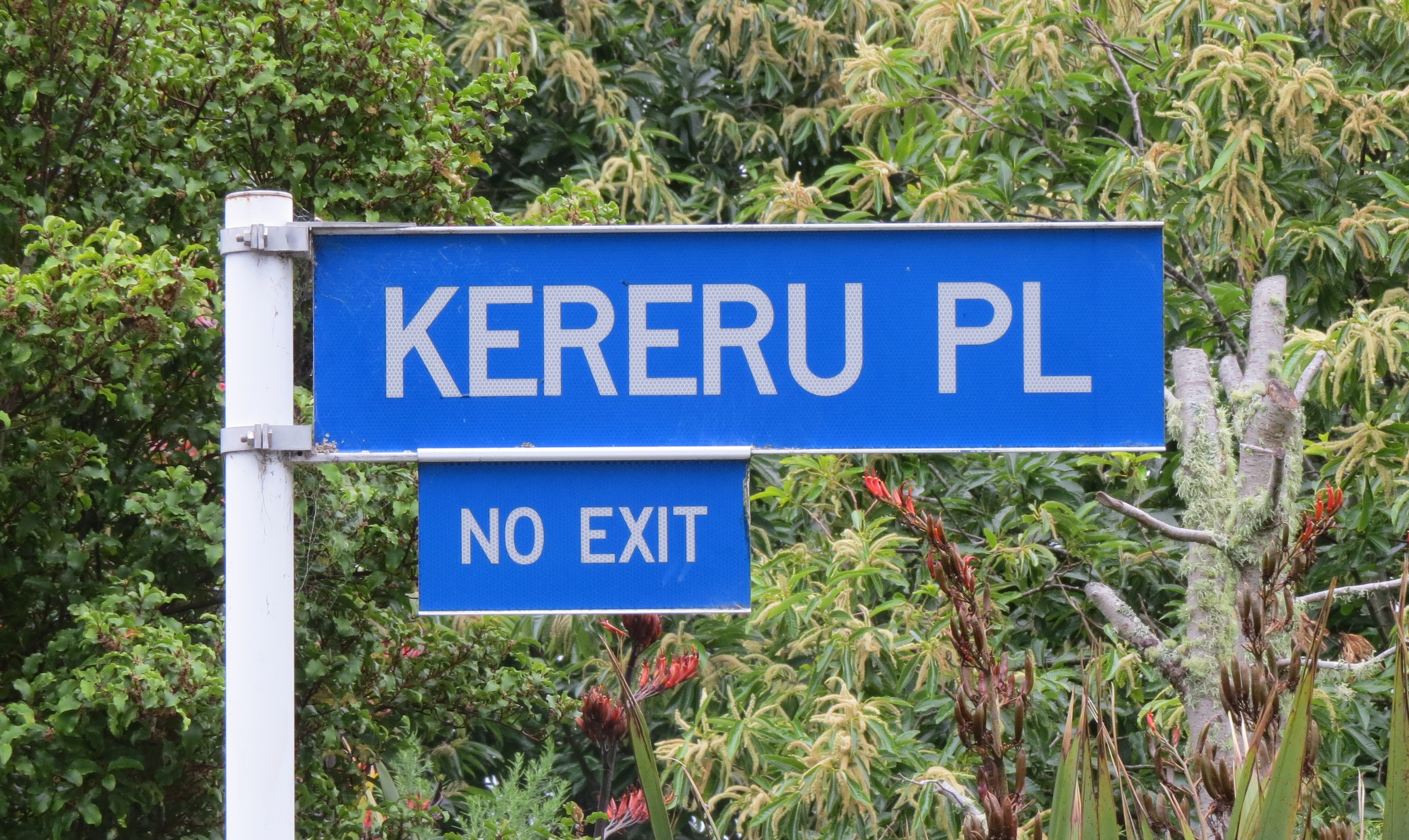
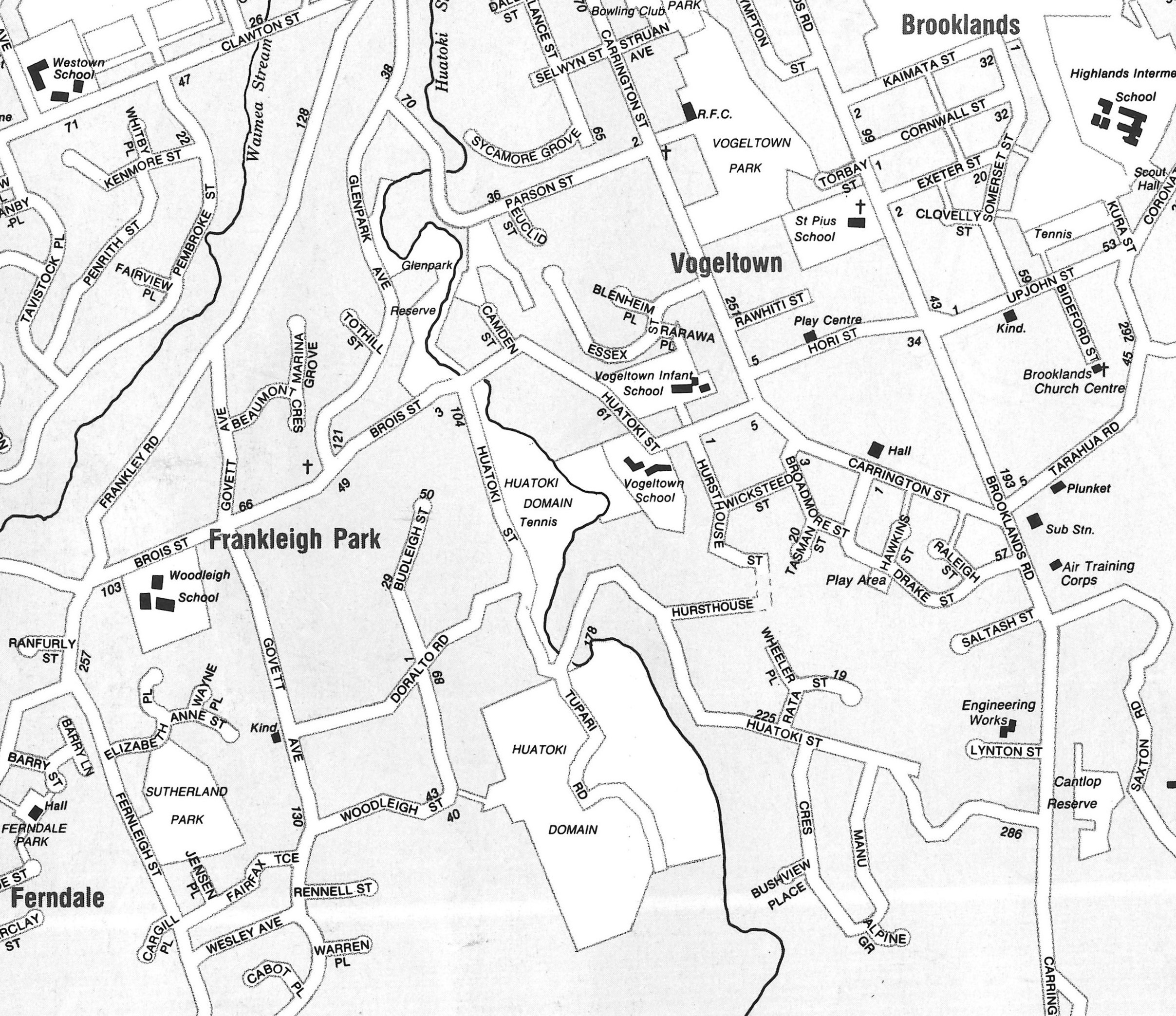
Kereru Place runs off Huatoki Street in Upper Vogeltown. Named in 1998, it had previously been part of Hursthouse Street which once connected with Huatoki below Vogeltown School. After the southern section was renamed, nearly a dozen houses hitherto located on Hursthouse Street had their addresses changed to Kereru Place. The two streets are still connected by a walkway, saving residents a longer journey to either the school or the Vogeltown shops.
The new street was named after the native wood pigeons which frequent the area. Kererū (Hemiphaga novaeseelandiae), also known as kūkū or kukupa due to their soft call, were once so numerous they could be snared in their thousands. According to Māori legend, Māui even travelled to the underworld disguised as a kererū – he was carrying his mother’s apron when he took the form of the bird, hence its white breast feathers. Kererū were said to have been most prolific around the area of Paynters Avenue in New Plymouth, but the introduction of kiore (rats) by Māori began the process of decimation. This increased exponentially after Pākehā settlers brought stoats, cats, possums and other predators to Taranaki and cleared the dense forest.
Fears that these beautiful birds might become extinct were raised as early as 1890 and legal protections were eventually introduced, with substantial fines for anybody caught killing one. Despite such efforts, by the 1930s kererū had become so scarce that they were rarely seen other than in Te-Papa-Kura-o-Taranaki (Egmont National Park) and locals were encouraged to plant native trees on Arbor Day to entice them back into towns. When two kererū were spotted in Pukekura Park in December 1937 it was reported in the Taranaki Daily News – residents would be astonished to know how many now call the central city home.
Measuring up to half a metre in length and 600 grams in weight, kererū are monogamous and can live for more than 20 years. Several satellite-tagged birds here in Taranaki have been recorded travelling as far as 60 kilometres to reach their favourite fruits like karaka and miro berries, ensuring they play a vital role in transferring seeds between remaining areas of native forest. They are no longer threatened but remain protected under the Wildlife Act of 1953.
This story was originally published in the Taranaki Daily News.
Related documents
Taranaki DP8092 Kereru Place (1956), ICS Pre 300,000 Cadastral Plan Index (Imaged by LINZ).
Please do not reproduce these images without permission from Puke Ariki.
Contact us for more information or you can order images online here.
The information on this website is provided for general research and reference only. While we try to keep content accurate and current, we make no guarantees about its completeness or correctness. It should not be considered a replacement for a LIM or a Property Report. Some content is supplied by third parties. Puke Ariki has not verified this content and users should check its accuracy before relying on it.The inclusion of a building on the website does not imply heritage status. See SCHED1 in the NPDC District Plan for a list of buildings that have rules about what can happen to or around them (administered by NPDC). See the New Zealand Heritage List for a list of buildings that are celebrated for their heritage significance but are not subject to rules (administered by Heritage New Zealand Pouhere Taonga). Should any corrections need to be made to the records or for more information please contact us.


