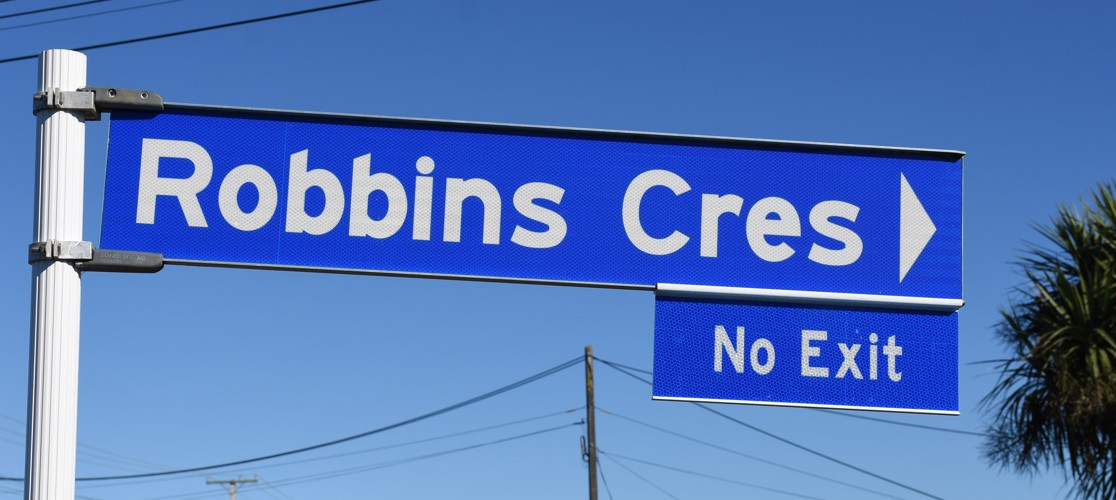
 Robbins Crescent sign (2021). Mike Gooch. Word on the Street image collection.
Robbins Crescent sign (2021). Mike Gooch. Word on the Street image collection.
Robbins Crescent sign (2021). Mike Gooch. Word on the Street image collection.
Robbins Crescent is a short cul-de-sac off Arygle Street in Hāwera and is named after a former mayor. Benjamin Conrad Robbins (1857-1953) was born in Nova Scotia and immigrated to New Zealand in the 1870s, first to Wellington and then to Hāwera in 1881.
Robbins opened a grocery store known as “The Nimble Sixpence” and according to his obituary was elected secretary of the Hāwera Volunteer Fire brigade on his first day in the town. So began nearly thirty years of service to the community in a variety of roles. He served as chairman of the Hāwera School Committee, Hāwera Hospital Board and the Hāwera Fire Board, as well as being a member of numerous other organisations.
As well as this commitment to public service he also played an important role in the dairy industry. Robbins was a champion of co-operative principles in the dairy industry and helped form the National Dairy Association.
He also found time to serve on the Hāwera Borough Council for 15 years and was mayor from 1902-6 and again for 12 months in 1907. It was during his mayoralty that King Edward Park began to be developed into the beautiful spot it is today.
Perhaps exhausted by his work in the town, Robbins moved to Tauranga in 1908. However the lure of local body politics proved too strong and only a few years later he was elected Mayor of Tauranga.
Although he stood unsuccessfully for parliament (Egmont and Tauranga electorates), in 1936 he was appointed by the first Labour Government to a seat on the Legislative Council – New Zealand’s upper house.
Robbins Crescent was surveyed in 1946 and Benjamin was able to attend an opening ceremony in his honour. He died in Whanganui in 1953, at the age of 97.
This story was originally published in the Taranaki Daily News.
Please do not reproduce these images without permission from Puke Ariki.
Contact us for more information or you can order images online here.
The information on this website is provided for general research and reference only. While we try to keep content accurate and current, we make no guarantees about its completeness or correctness. It should not be considered a replacement for a LIM or a Property Report. Some content is supplied by third parties. Puke Ariki has not verified this content and users should check its accuracy before relying on it.The inclusion of a building on the website does not imply heritage status. See SCHED1 in the NPDC District Plan for a list of buildings that have rules about what can happen to or around them (administered by NPDC). See the New Zealand Heritage List for a list of buildings that are celebrated for their heritage significance but are not subject to rules (administered by Heritage New Zealand Pouhere Taonga). Should any corrections need to be made to the records or for more information please contact us.