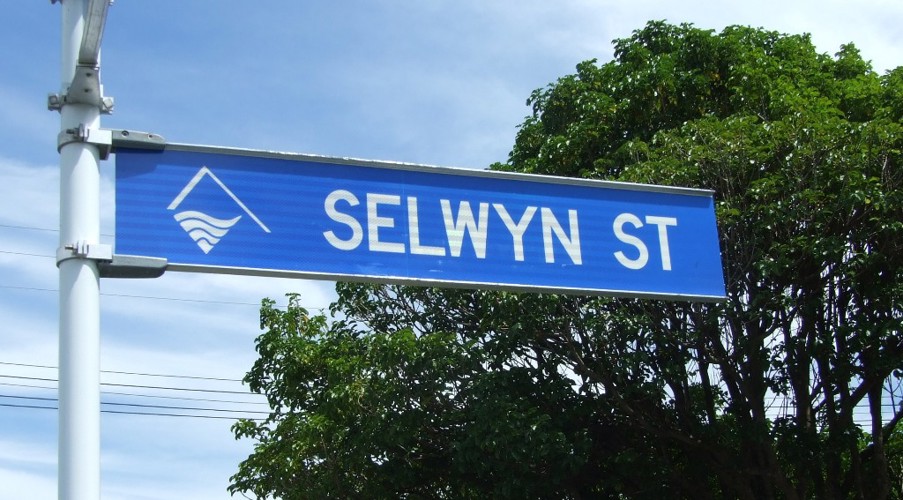
 Selwyn Street sign (2012). Mike Gooch. Word on the street image collection.
Selwyn Street sign (2012). Mike Gooch. Word on the street image collection.
Selwyn Street sign (2012). Mike Gooch. Word on the street image collection.
George Augustus Selwyn was the first Anglican Bishop of New Zealand.
Born in London 1809, Selwyn was educated at Ealing, Eton and St John's College, Cambridge. He rowed for Cambridge in the first Oxford and Cambridge boat race at Henley in 1829. After graduation he tutored at Eton, where he established rules for the safe use of the river which had been previously out of bounds.
Consecrated at Lambeth in 1841, Bishop Selwyn sailed for New Zealand, stopping in Sydney on the way. During the voyage he learned te reo Māori from a boy returning from England. An astute student, he was able to preach in Māori on his arrival.
Selwyn travelled widely, including trips to the Pacific islands that were included in his diocese.
He was remembered as an independent and unusual house guest. He stayed as a guest of John Gorst at Te Awamutu, who later recalled: "A very original guest; his principle, as he told me, in staying at people's houses in the bush was to give no domestic trouble of any kind. He made his own bed, he tidied up his own bedroom, he cleaned his own boots, and even washed his own clothes."
Bishop Selwyn is credited with establishing the Anglican tradition in New Zealand. He returned to England in 1867, and was appointed bishop of Lichfield the following year. He died in 1878 at the age of 69, and was buried in the grounds of Lichfield Cathedral.
This story was originally published in the Taranaki Daily News.
Please do not reproduce these images without permission from Puke Ariki.
Contact us for more information or you can order images online here.
The information on this website is provided for general research and reference only. While we try to keep content accurate and current, we make no guarantees about its completeness or correctness. It should not be considered a replacement for a LIM or a Property Report. Some content is supplied by third parties. Puke Ariki has not verified this content and users should check its accuracy before relying on it.The inclusion of a building on the website does not imply heritage status. See SCHED1 in the NPDC District Plan for a list of buildings that have rules about what can happen to or around them (administered by NPDC). See the New Zealand Heritage List for a list of buildings that are celebrated for their heritage significance but are not subject to rules (administered by Heritage New Zealand Pouhere Taonga). Should any corrections need to be made to the records or for more information please contact us.


